Supplements can help but they’re the last 5%, not the first 95%.
- Your training program matters more
- Your nutrition matters more
- Your sleep matters more
You can’t out-train bad habits.
And there’s no such thing as overtraining—only under-recovering.
What Actually Works (and How to Use It)
Aging doesn’t mean slowing down, it means being smarter. Recovery takes longer, muscle loss accelerates, and fatigue hits harder. The right supplements can help… but only if you use the ones backed by real science.
Research consistently shows only a small group of supplements have meaningful ergogenic effects: creatine, beta-alanine, caffeine, nitrates, and sodium bicarbonate.
Let’s break them down.
Creatine
Best for: Strength maintenance, recovery, muscle preservation
What it does
- Increases phosphocreatine stores = faster ATP (energy) regeneration
- Helps offset age-related muscle loss (huge after 40)
Performance impact
- Improves repeated efforts, sprint finishes, and strength
- Indirect endurance benefit via better training quality
Recovery benefits
- Supports muscle repair and cellular hydration
- May reduce fatigue between sessions
Dosage
- 5 g daily
- Optional loading: 20 g/day for 5–7 days
Timing
- Daily consistency matters more than timing
Science
- Widely recognized as one of the most effective supplements available
Bottom line:
Not just for lifters. For 40+ endurance athletes, this is insurance against muscle loss and poor recovery.
Collagen
Best for: Joint health, tendon integrity (key after 40)
What it does
- Provides amino acids (glycine, proline) for connective tissue
Performance impact
- Indirect (keeps you training consistently)
Recovery benefits
- Supports tendon and ligament repair
Dosage
- 10–15 g collagen + 500mg vitamin C
Timing
- 30–60 minutes before training (for tendon loading)
Science
- Growing evidence supports tendon and joint benefits (not performance)
Bottom line:
This is a longevity play, not a performance boost.
BCAA (Branched-Chain Amino Acids)
Best for: Honestly… not much if your diet is solid
What it does
- Provides leucine, isoleucine, valine (muscle signaling amino acids)
Performance impact
- Minimal if protein intake is adequate
Recovery benefits
- Slight reduction in muscle soreness in some studies
Dosage
- 5–10 g during or after training
Timing
- During long sessions (if used at all)
Science reality check
- Compared to whole protein, BCAAs are inferior
- Not among the evidence-based top-tier supplements
Bottom line:
If you’re eating enough protein, skip this. Save your money.
Nitrates (Beetroot Juice)
Best for: Aerobic efficiency and endurance
What it does
- Converts to nitric oxide = improves blood flow and oxygen efficiency
Performance impact
- Improves endurance performance and exercise efficiency
Recovery benefits
- May improve blood flow = faster nutrient delivery
Dosage
- 400–800 mg nitrate (~500 ml beetroot juice)
Timing
- 2–3 hours pre-race or key workout
Science
- Strong evidence for endurance benefits
Bottom line:
One of the few supplements that actually makes endurance work feel easier.
Beta-Alanine
Best for: High-intensity endurance (intervals, climbs, surges)
What it does
- Increases muscle carnosine = buffers acid (delays fatigue)
Performance impact
- Studies show it increase time to exhaustion, improves fatigue resistance and boosts peak power
Recovery benefits
- Reduces muscular fatigue during repeated efforts
Dosage
- Up to 6 g/day (3 split doses to avoid tingling)
- Starting with 0.5g for 3days and increasing by 0.5g every 3days over 28days.
Timing
- Daily loading for 2–4 weeks (not acute)
Science
- Supported as an effective ergogenic aid
- It combines with histidine in the muscle to form carnosine, which acts as a buffer against hydrogen ions that build up during exercise, preventing muscle pH from dropping.
Bottom line:
If your races include surges, hills, or suffering…. this helps but it needs time to load into the system.
Caffeine
Best for: Race Day performance, mental sharpness
What it does
- Stimulates CNS = reduces perceived effort
- Increases fat oxidation and alertness
Performance impact
- Small but consistent improvement in endurance performance
Recovery benefits
- Minimal (this is a performance tool)
Dosage
- 3–6 mg/kg bodyweight
Timing
- 45–60 minutes pre-event
Science
- One of the most proven performance enhancers available
Bottom line:
Still king. Just don’t abuse it or ruin your sleep.
Sodium Bicarbonate
Best for: Short, intense endurance efforts (intervals, finishing kicks)
What it does
- Buffers acid buildup = delays fatigue
Performance impact
- Improves high-intensity endurance performance
Recovery benefits
- Helps tolerate higher training intensity
Dosage
- 0.2–0.3 g/kg bodyweight
Timing
- 60–150 minutes pre-event
Science
- Strong ergogenic evidence
Warning
- High risk of GI distress (test before race day)
Bottom line:
Effective—but brutal if your gut can’t handle it.
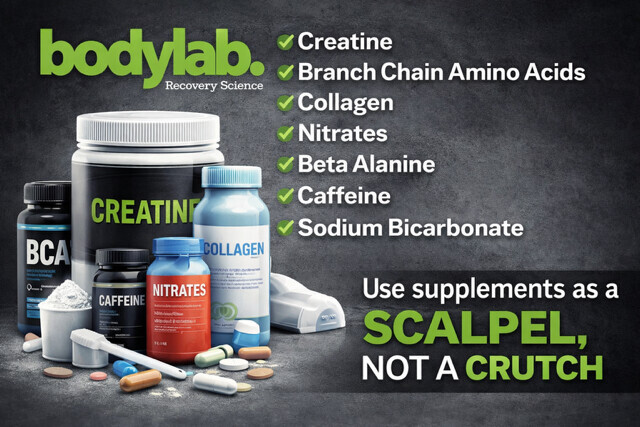
Use supplements like a scalpel, not a crutch.
About the Author:
“Big Matt” is a seasoned strength and conditioning coach with over 22 years of experience as a competitive athlete. His career spans elite sport and high-performance development, including serving as an IPC technical official and a Head Coach for Team Canada.
Matt brings a unique perspective shaped by his time with one of the world’s largest supplement companies, combining practical experience with science-backed strategies. With a deep understanding of what it takes to perform at the highest level, Matt has worked with athletes across many disciplines, helping
them reach and stand on their respective podiums.
His philosophy is simple: peak performance isn’t just about winning, it’s about longevity, resilience, and enjoyment. He places equal value on those who perform at their best with confidence, recover efficiently, and stay injury-free.
For Matt, success is measured not only in medals, but in sustainable performance and athletes who genuinely love what they do.

.jpg)